
Money, and how we relate to it, can be viewed as a landscape. Like the physical world, there are many paths that connect the different areas. There are barren, desolate places, dirty areas, and lush green areas. In some of the places we can see what people have done in the land. It can be built up or run down, growing or declining.
We get to choose how we relate to money, and where we spend most of our time in this landscape of money. I wrote this post while reading Lynne Twist’s book The Soul of Money, which is a highly recommended book on Canoosa’s book list.
It’s An Experience
Our relationship with money is an experience, not an amount or a destination. We can look at others and compare ourselves with them. A common belief is that more money will fix our financial problems. It might temporarily help, but like a weed that is cut back, it will just show up again.
Some people have money, but wish they didn’t, because they didn’t earn it – it’s family money.
There are also people who are so poor that all they have is money. They are short on life skills, short on friends, with strained family relationships. They have money, but not true wealth. It’s not how much we have or don’t have, it’s our relationship with money that makes a huge difference.
Scarcity
Scarcity is lack, and in relation to money, it is the lack of money. A good number of people would like to earn more. But how much more, exactly?
Interestingly, scarcity can also be a driver for accumulating money. The person driven by the fear that they will lose their money, or that it will be stolen. Others are driven by a need to prove themselves to others. That is scarcity thinking as well.
I wrote a post about Scarcity In Abundance, about how stockpiling items in our lives is driven by scarcity thinking. When we get to the root of our fears about money, we will find scarcity there.
Sufficiency
When we travel on our path away from scarcity, we will find peace in sufficiency. Realizing that we not only have enough, we are enough. We are good, complete as we are. By viewing ourselves as complete, we can then allow ourselves to grow. Think of a garden… Is a small garden incomplete? A larger garden complete? If so, is there a size makes a garden “complete”?
Mother Teresa ran her whole charity on this idea of sufficiency. She did not keep excess cash reserves. When they needed money, she would pray, and God delivered. While she managed this with an organization of over 400 locations, this may not be the appropriate solution for you.
Focusing on sufficiency, knowing that there is enough, steers a person away from chasing more and more and more. Sufficiency means being content with what we have, without lowering our standards or settling for less. This mindset helps us calm down, relax, and allow more peace in our lives.
Abundance
At Canoosa Finance, abundance is seen as sufficiency plus one. This is where the 1-Up Mindset comes into play. It is sufficiency with a buffer of one. That “one” could be a single item, two or three items, or a case – it depends on your situation.
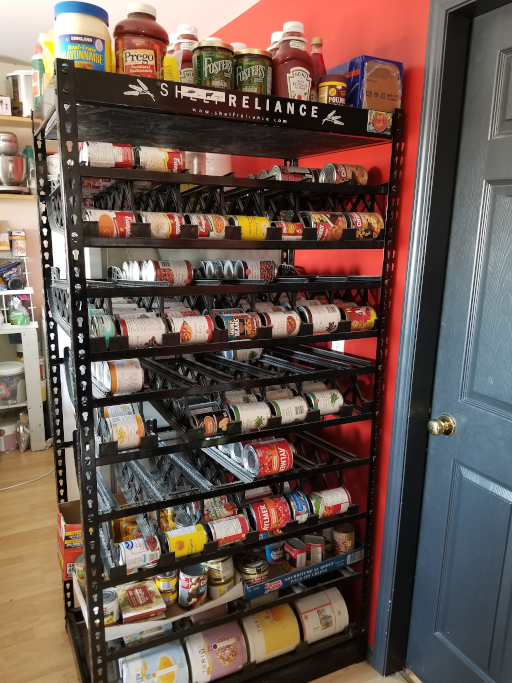
When we experience abundance, we can be intentional. If you’ve been on a cruise ship, you know how there is almost always food available. Knowing there’s food available now, and there will be food later, means I don’t need to “run the ship out of food” by eating too much.
We empower ourselves by listening to ourselves. Why force ourselves to eat if we aren’t hungry? Others are there to eat the food as well… we might as well let them enjoy it! If I’m not hungry, I will even skip a meal on the cruise ship. So what? I would rather listen to my body than be pressured by scarcity into “getting my money’s worth.” Isn’t the whole cruise the worth of the ticket?
Extravagance
When we venture into the land of extravagance, it is usually more for the sake of having more, or for impressing others. This is the neighborhood where greed, envy, and jealousy live. It’s about accumulating and chasing more.
By no means am I saying that it’s wrong to have nice things. It is worth questioning our behavior when we notice we’re no longer enjoying what we’re doing. If you prefer the smaller cruise ships over the large ones, enjoy sailing on the ships you love.
Comfort Zone
The area we live in is called our comfort zone because it is comfortable and familiar. Even if we don’t like everything in our comfort zone, we know the problems. Sometimes those problems even become like old friends. (And we can even miss them if we don’t see them in a while!)
Our home is a physical comfort zone. We feel safe there. Even if we are not living in our ideal home, it is still our little place in the world.
Familiar Zone
The area outside of our comfort zone is our familiar zone. We feel more vulnerable here. As we explore new areas, we will find that our familiar zone increases.
Think of this as the town you live in, maybe the surrounding towns. You are familiar with them, yet they don’t carry the same comfort as home.
The Great Unknown
This covers the parts of your life you haven’t explored yet. They’re filled with uncertainty and feel unfamiliar. It can be intimidating to go somewhere new, or to try something you’ve never done before.
Sometimes things here can feel wrong, or we feel unsure of ourselves. That’s normal here in the Great Unknown! After spending some time here, we can always return to our familiar zone and our comfort zone.
Learning to accept uncertainty in our life allows us to venture more often and farther into the unknown. Eventually, we can get to the point where we look forward to new things because we know that we can handle them just fine.
Our Financial Landscape
We can learn about various financial products (bank accounts, credit, money itself), financial services (banks, lenders, credit agencies), and our thinking about money (assumptions, scripts, emotions). As we learn about finances, we start to become familiar with the terms and concepts. From there, we can try out what might improve our life.
It’s liberating to understand that we are complete just the way we are. We can stop chasing more and more. By appreciating what we have, we often find that we have more than we thought. That allows us to give more, and to cooperate and collaborate more.
As ironically as it may sound, by stopping forcing ourselves to grow, we often find that we are growing more. It is in this way that we create a life that we love and become unstoppable. Sign up with Canoosa Finance and get new posts delivered to your inbox.
Post Disclaimer
I am just a guy sharing financial concepts that have worked for me. The information on this site may or may not apply to your specific situation and is intended for informative purposes only and is not a replacement for legal or professional advice. Please do your own due diligence. Any ideas that you choose to apply, you do so on your own free will and at your own risk. This site is opinion-based and these opinions do not reflect the ideas, ideologies, or points of view of any organization affiliated or potentially affiliated with this site.